Friday, March 20, 2009

From Karin's time to our days


Pergolas were popular in the last turn of the century as they provided shaded outdoor sitting areas. Photo of Villa Pergola in Saltsjö-Duvnäs 1907; courtesy of Nacka lokalarkiv.

As I wrote in my post about Karin Larsson, the way how gardens in Sweden were designed and planted underwent many changes during the late 19th century and early 20th century, partly due to economical and sociological changes in the society. One and a half years ago while in Sweden, I held a presentation and wrote an article of this period and gardens together with a friend. When doing research for that presentation, we gathered and scanned in a large amount of archive material in form of old photographs and post cards. I thought it might be interesting to continue on this theme and show a tiny part of this material here.

Sitting in the garden in the end of the 19th century; trees were rewered and left even in quite impractical places, as here by the pathway. Tegelön, Villa Berga 1900, photo courtesy of Nacka lokalarkiv.

As I wrote earlier, at this time a new, quite well-off middle class had developed as a result of industrialism during the 19th century. Many of the well-off people fled from the the crowded and filthy cities to the undisturbed nature and even whole residential areas were built to provide healthy and beautiful surrounding to families that could afford them. Those not so lucky often chose to emigrate as an effort to improve their lives; totally over 1,3 million Sweden left the country during the 19th and early 20th century; a huge percentage of the population of a country with only ca 5 million inhabitants in total. To curb this development, a movement called Egnahemsrörelsen started to promote the ownership of houses and gardens even to those with smaller resources. This in essence very nationalistic movement had international roots; similar housing developments and garden cities had been seen both in England and in Germany.

Family sitting in front of their small house, Klockargården, 1900. Their garden is mostly used for growing edibles. Photo courtesy of Stockholms Länsmuseum.

Blooming potato plants in front of a small house, Sjöviken 1900. Photo courtesy of Stockholms Länsmuseum.

So, if things are simplified quite a bit, three main styles of garden were typical during this period. The smaller houses, "egnahem" like the ones above, had much of their garden allocated to fruit trees and kitchen gardens, even if the owners often grew ornamental plants, often in flowerbeds near the house or as edging the pathways. Typical plants besides edibles were Syringas, peonies, honeysuckles, Philadelphus, bush roses, and other hardy and easy to propagate garden stalwarts.

A newly planted garden in the formal or architectural style; Herrgårdsvillan i Saltsjö-Duvnäs, early 1900's. Photo courtesy of Nacka lokalarkiv.


A garden in the natural style, interestingly combined with a kitchen garden in front; Skepparbacken 1 in Saltsjö-Duvnäs, early 1900's. Photo courtesy of Nacka lokalarkiv.

Houses for the better off, which in Sweden are called "villas" after a word of Italian origin, had gardens in the "formal or architectural style" or in the "natural style" - or even combined these both, if the owner could not quite decide or thought that this was needed for the situation. August Brunius, a well-know Swedish writer of this time, described these styles in his book Hus och Hem (House and Home) from 1912. He wrote that the formal or architectural style took the building as starting point and followed its geometrical plan into the garden with straight lines and pathways, walls, terraces and stone laid sitting areas. The natural style avoided disturbing the nature around the buildings and followed the lines of the nature, with curved pathways and often rounded forms. According to Brunius, the style of the house and the character of the owner (!) should guide which style should be chosen, or if these should be combined (which actually was typical for the gardens of the Arts and Crafts movement). Of course, Brunius ideas did not develop in insulation, but followed closely the discussion of his time and his predecessors; for example William Robinson's and Reginald Blomfield's fights between the naturalistic and the formal gardening styles to mention one of the most famous garden controversies.

A garden in the natural style; Bergvägen in Saltsjö-Duvnäs, early 1900's. Photo courtesy of Nacka lokalarkiv.

Bergvägen in Saltsjö-Duvnäs in 2007; almost no traces are left of the original garden; the house stands totally exposed, with only one old pine tree to the right to shade or give proportion to it.

A garden in the natural style; with typical picket fence, flag pole and a sitting group in the shade. Most of the trees around the house have been saved while building the house to make it sit in the landscape. Bergvägen in Saltsjö-Duvnäs, early 1900's. Photo courtesy of Nacka lokalarkiv.

The same house at Bergvägen now; no trees left, only lawn and more lawn...

It is difficult to say if we have made any progress in gardening within the last hundred years; when looking at the pictures above, I would claim the opposite. So often, when listening to my garden customers in Sweden, they told they "did not have any garden" or that they only have these "horrible conifers" (mostly firs and pine trees). The ordinary house owner seemed either to be afraid of real nature and/or have forgotten everything that was held in value for hundred years ago; that the beauty of nature itself could be appreciated, even very near our abodes. (And here, I don't mean the naturalistic plantings that have been popular for the last ten or fifteen years; beautiful as they are, they still are highly arranged works of gardening, often with many plants not native to their countries.) I understand that for some of us, a garden with this much "nature" could be too much to bear and that many prefer cultivating their gardens in a more elaborated style; but wouldn't it be lovely if we could at least partly revive the thinking from Karin's time and keep some of these gardens intact?

Friday, March 13, 2009

In the garden with Karin Larsson


Karin by the shore, watercolour by Carl Larsson; she seems to be contemplating the handsome lilies, almost past their prime.

Is there any thing more essentially "Swedish" than Carl Larsson's paintings and drawings? In Sweden and maybe even in the rest of Scandinavia, we are so familiar with his art from the turn of the previous century, that we almost don't even think about it; there it is, as part of the cultural and visual landscape, seducing the eyes with its beautifully curved Art Nouveau lines and harmonious colours. It is easy to forget that Carl's paintings depicted surroundings that were quite avant garde for their time and that they really don't represent a typical Swedish home from the turn of the previous century.
K

Karin in the atelier, watercolour by Carl Larsson.

This year, it is 150 years since the birth of Karin Larsson, Carl Larsson's wife. She was an trained artist and had met Carl while painting in France. They married in 1883 and after their first child (of eight in total) was born in 1884, Karin put her paintbrushes aside, giving her full attention to her home and family. In 1888 the family moved to Lilla Hyttnäs in the village of Sundborn in Dalarna, about 230 km North-East from Stockholm. Their house with its gardens became the center of Karin's creativity, and she filled her home with colourful embroideries, weavings and practical furniture of her own design. In addition, she loved her garden and decorated her home with exotic plants and artistic flower arrangements.
K

Flowers on the windowsill. From the book "A Home" (26 watercolours in total). Plants include pelargoniums, clivia, oleander, ivy and Christmas cactus (Schlumbergera).

Model with postcards, watercolour 1906. Note the beautiful springtime flower arrangement with soft pink tulips and willow branches.

Although often thought as quintessentially Swedish in their style, both Carl and Karin were very much inspired by John Ruskin and the Arts and Crafts movement founded by William Morris, as they subscribed to The Studio, a magazine that spread these ideas and aesthetics. Just like many of their contemporaries, they admired Japanese art, which was made accessible during this period through prints. In Carl Larsson's paintings, we are actually looking at Karin's designs through Carl's skillful brushwork. It is interesting to see, how the influences above lead to so different results; Karin produced abstracted, strong and quite "pre-modern" designs, often with vegetative motifs for textiles and furniture, while Carl executed his paintings in a highly ornate, intricate but airy style. The only area where Karin's style reminds of Carl's is in her delicate flower arrangements, like Dalecarelian origami combining both wild and garden flowers. Still, their combined contributions created a perfectly balanced and harmonious whole.

Lisbeth reading, watercolour 1904. Note the blooming Christmas cactus (Schlumbergera).

Brita at the piano (1908); flower arrangements by Karin are almost always present in Carl Larsson's paintings.

Letter-writing (1912); what a lovely and practical green flower shelf designed by Karin Larsson.

At the time when Karin and Carl Larsson were active, a new, quite well-off middle class had developed as a result of industrialism during the 19th century. During this period, many of these well-off (but not necessarily rich) people fled from the the crowded and filthy cities to the undisturbed nature; many artists, as writers Selma Lagerlöf and Ellen Key, painter Anders Zorn, and Karin and Carl, are good examples. Even whole residential areas, like Djursholm and Saltsjöbaden outside Stockholm, were built to provide healthy and beautiful surrounding to families that could afford them. The garden fashions in Sweden underwent a considerable change, as the needs of these people were not just growing plants for food, but to spend time and entertain in their gardens. Garden became a place to relax, to eat, to work and to play; it needed to have places to sit and large trees to provide shade when the sun became too strong. The idea of "a wild garden", promoted in England by William Robinson, took ground in Sweden during this time; flowers were allowed to grow freely in meadow-like beds, even if more structured borders were typical around the house. Karin had also a large kitchen garden; in France she had seen and tasted vegetables not usually grown in Sweden, and included these into her garden and greenhouses. Some of these were asparagus, tomatoes, different kinds of lettuce, black radish, rhubarb, chervil, sorrel, strawberries and many more. Karin also grew a large variety of Mediterranean plants like pelargoniums, myrtle, nerium oleander, agapanthus and camellia, all pictured in full bloom in Carl's paintings.

The Bridge (1912); with beautiful icelandic poppies flowering in the front.

Harvesting time in the kitchen garden; Shelling peas (1908). Note the handsomely blooming Echinopsis in the background.

It was actually Karin who gave Carl the idea of picture their home and gardens in his paintings. Books and reprints about their home were produced in large editions, and the original aquarelles were presented at the Stockholm exhibition in 1897; very few homes have had such a huge publicity. Karin's ideas on interior design, colours and gardens were trendsetting at the time and continue even today to inspire people all over the world. There has been many exhibitions of the Larssons' work, the most well known of which might be the one arranged by the Victoria and Albert Museum in London in 1997. This spring and summer, Sofiero Palace and Gardens in Helsingborg in Southern Sweden are celebrating Karin as an artist, craftswoman and expert gardener with an exhibition called "On the Sunny Side at Sofiero" (30 May - 27 September 2009). It will be interesting to see Karin herself in focus at last, and get a closer look at her world and work.

More about Carl and Karin Larsson: Carl Larsson gården Sundborn.

Exhibition "On the Sunny Side at Sofiero".

Monday, March 9, 2009

Mossages - a modern take on moss

*
Just to continue the moss theme I posted about for a couple a days ago...

Anna Granborne created project Sporeborne that was featured in Creative Review, Oct 2008. According to her web site, writing with moss seemingly represents an unusual synthesis between advanced civilisation and nature. She writes, that it gives a chance for us to speak as individuals and artists, but also to be the spokesperson of organisms which have no voice in our world. She hopes that not only the words will be noticed, but also the moss itself, put to the forefront through it's sculpting, fashioned into a form we can understand.
K
There is no looking back now; mosses are at last in the limelight, humble and small as they might be.
K
K
Thanks and all pictures with © :

ABE/Anna Garforth
http://www.crosshatchling.co.uk/
annagarforth@gmail.com
+44 (0)7910 558 394.
K

Sunday, March 8, 2009

About loving gardening books

K
KK
Today, it is miserably cold and wet, so instead of going outside I am really happy to stay indoors with a cuppa and a book full of gardens and gardening. I shoud have grown out of buying books a long time ago, but somehow they keep asking me to be taken home with me. Buying online is what I do most often today, but while in Sweden, I loved driving to a huge "Salvation Army" type of charity store, Myrorna, in Skärholmen, and browsing their large shelves for great finds. Once, I spotted a large, leather bound book on the shelves. It proved to be the German immigrant Daniel Müller's Trädgårdsskötsel (Gardening or Gardener's Advice, three parts bound together) from 1888 in third edition, a wonderful book that first was published between 1848 and 1853, and greatly influenced Swedish gardeners during the second half of the 19th century.

Forcing wild strawberries in a heated bench.
K
How to plant urns with Dracena and Phormium - plants so trendy in the 1990's and 2000's...
K
My edition of Trädgårdsskötsel seems to have been loved by other gardeners before as it is quite worn out, but with its finely engraved pictures and detailed descriptions of how to plan and plant a garden it is one of my favourite garden book finds. It is lovely to read about what was considered "tasteful" in those days, or to look at the elaborated pictures of ways to train fruit trees - some of them clearly meant only to impress the readers and not to be tried in real life (or what do you say about a grape-vine trained like a wine goblet?). What I regret is that I didn't buy almost any of the garden books from the 1960's and 1970's, a period when gardening was mainly about Berberis and hybrid roses. These books were nearly free as nobody wants them now, but the pictures being downright ugly (I know this is a very subjective statement...), I left them to the shelves. Now I think that I should have included them in my collection as witnesses of that time period - and you can always learn something about gardening and garden styles, even if you don't personally like them.

Part of a larger garden in the English style.
K A garden in the German style.

So, for a book loving person like me, the 4th annual Garden Lovers’ Book Sale on April 3rd and 4th at the Elisabeth C. Miller Library is a real treat. Thousands of used gardening, horticulture, botany and landscape design books will be for sale and all proceeds of the sale are used to purchase the best and newest in horticultural books and journals for the library. Book donations will be accepted until March 31, and admittance to the sale is free.

All pictures are from Daniel Müller's Trädgårdsskötsel (1888).

Saturday, March 7, 2009

Last chance to see the Pacific Rim Bonsai Collection

Mugo pine and Ezo spruce, Pinus mugo and Picea glehnii, bonsai since 1985.
K
Update from June 2010: the Pacific Rim Bonsai Collection exhibit is open again, 6 days a week. Check out their website for times.
*
It feels like there's no end to to the bad news these days... Today, I learned the the famous Pacific Rim Bonsai Collection show garden will be closed in end of March 2009 until unknown date in the future. Due to the recession, the Weyerhaeuser Company that owns of the collection, has decided to close the display garden to the public, which is a pity as the collection is truly amazing. As the web site states, it is like an outdoor museum of living Asian art and it is located in a beautiful woodland setting within the Weyerhaeuser Company's corporate campus. It features 60 outstanding bonsai from six Pacific Rim nations. These miniaturized, living trees shaped have been by bonsai artists to portray scenic large trees in nature. Some bonsai create a vision of a serene, benign environment, while others suggest the drama of trees clinging to sheer mountainsides or windswept rocky shores.
K
This Chinese hackberry, Celtis chinensis, has been trained as bonsai for more than 40 years.
K
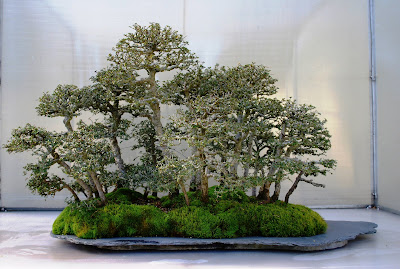
Catlin elm, Ulmus parvifolia 'Catlin', a miniature grove of 20 small trees.
K
Willow-leaf fig, Ficus salicifolia, bonsai since 1986.
KK
While I visited, the bonsai were still in their wintertime shelters, which is understandable, but visually a bit disappointing. Otherwise, I loved the detailed way the process of creating bonsai was explained, together with interesting facts about the bonsai pots. It really is a pity that this lovely, specific exhibition will disappear from the public sight, so check it out while you still have a chance!
K
K
Luckily, the Weyerhaeuser Company will keep the bonsai trees and continue to employ the curator and one full-time gardener to take care of these little treasures. I hope that they still keep their excellent web pages up, as they have good pictures and detailed information about the bonsai on display, information about the art of bonsai, a list of suggested reading and videos, other bonsai and penjing displays in the United States, and bonsai club websites and Internet resources.
K
Trident maple, Acer Buergerianum, bonsai since 1880, about 8 feet high. This tree was imported from Japan for exhibit at the 1915 Panama-Pacific Exposition in San Francisco. It was bought after the exhibition by nurseryman Kanetaro Domoto in California and kept in the Domoto family until it was included in the Pacific Rim Bonsai Collection.
K

A stumpery in progress...

K
I admit that I am not the biggest fan of rhododendrons (good, reliable plants for many situations, but they really don't tickle me...), but I decided to check out the Rhododendron Species Foundation & Botanical Garden, while visiting the adjacent Pacific Rim Bonsai Collection today. As expected, it was far too early for anyone else than the most hard-core rhodo enthusiasts to visit this garden; almost nothing was flowering yet (besides a bright, Christmas-red variety). Instead, I found the staff in full swing creating a stumpery, mainly using stumps from large trees taken down by the winter storms. The area will be planted mainly with ferns, and I expect it to be an interesting visual addition to the garden.
K
K
Stumperies were quite popular in 19th century gardens, and the first known example of them was built in 1856 at Biddulph Grange in England. They seemed long to have been buried with other Victorian horticultural oddities, until Prince Charles a couple of years ago chose to create a secret stumpery at his Highgrove estate. They have been gaining popularity since then, and as stumperies provide a good home for wildlife as stag beetles, toads and small mammals, I can't see any reason for not including them in gardens (you might need a fair-sized one though...).
K
K
Definitely worth visiting for anyone interested in species rhododendrons, The Rhododendron Species Foundation & Botanical Garden is a non-profit membership organization dedicated to the conservation, public display and distribution of them. The park has one of the largest collections in the world, with over 600 of the more than 1,000 species found in the wilds of North America, Europe, and Asia, as well as the tropical regions of southeast Asia and northern Australia. As Steve Hootman, the curator for the collections, mentioned while I was visiting today, conservation has become very important in recent years with the destruction of Rhododendron habitat in many areas of the world. Most of the plants here are grown from seeds collected by Steve and other plant collectors.
K

If you are interested in having a really special rhodo in your garden, visit the Plant Sales Pavilion for unique plants; the Foundation also has a mail-order catalog loaded with rare plants available for shipping or pick up. The gardens are located at Federal Way, ca 25 miles South from Seattle in Washington.

Thursday, March 5, 2009

Magic carpets of spring

Self-sown, pink Helleborus orientalis-hybrids by the creek.
K
Yesterday, I wandered past a truly magical garden. From the street, I could glimpse thousands of snowdrops covering the soil, mingling together with Hellebores and other spring bulbs. So I could not keep myself from knocking on the door today, I was so curious about seeing more despite the gray weather (I don't often invite myself to other people's gardens...). Marian opened the door and friendly allowed me to take some photos, and even invited me to come back when the weather gets better, so that we can have a closer look at all the treasures growing in her garden. It is situated on a slope and a small creek runs beside it, and the bulbs and Hellebores have self-seeded themselves happily in these ideal conditions. It really felt like the plants were having a party of their own, showing off their beautiful new spring dresses for each other. What a wonderful, harmonious feeling this garden has, I thought while I wandered through it.
KK
Cyclamen and snowdrops under a Hydrangea.
K
A spotted white Helleborus-hybrid together with snowdrops; a darker Helleborus variety and Narcissus coming up in the background.
K
Hundreds and hundreds of Hellebores; I've never seen so many in my whole life - Marian has tens of square feet covered with beautiful plants, all in full flower.
K
Snowflakes, Leucojum vernum, look similar to snowdrops, but have bigger and more bell-shaped flowers with distinct green or yellow markings on the tips.
K
More Hellebores...
K A sea of snowdrops and almost black Hellebores; they are so beautiful, but oh so difficult to catch on photos...
K
I just have to share some pictures of this magical place, my photos truly do not make justice to the beauty of Marian's garden or her plants. Hopefully the sun comes out soon, as I can't wait to get back to meet her and see these beauties again.

Tuesday, March 3, 2009

A closer look at mosses

A typical Finnish coastal forest with grey granite cliffs, mosses, heathers and pine trees. Photo by Karl-Dietrich Bühler, in "The Scandinavian Garden" (2000).
KK
I probably am genetically predestined to love mosses. When I was small, I loved to sit on the grey granite cliffs and moss-covered rocks of the coastal South-West Finland; looking at the ants in work, climbing over the different mosses like in a miniature forest. In the autumn, cranberries gloved with their bright red globes like small lanterns on the mosses. I still can feel the smell of sun-warmed moss on the grey granite cliffs, combined with the luxurious smell of small, orange or brown chanterelles, peeking up between the mosses. And in my garden in Saltsjöbaden, I could not see any reason for taking my neighbour's advice of replacing my emerald green moss carpet with a new roll-on lawn turf despite repeated "hints" from him.
K
Rock cap moss (Dicranum) growing on an old fence in Clyde Hill, near Seattle.
KKMMoss-covered azalea branches at the Azalea Walk at the Washington Arboretum.
K
For years, most gardening advice concerning mosses has been about getting rid of them. But recently, this beautiful and hardy plant that has been around for at least 450 million years, has become more popular as an alternative to the traditional lawn. Maybe the great interest in Japanese gardens, where mosses have traditionally had a prominent place, has influenced us aesthetically.
K
Moss path at the Seattle Japanese Garden at Washington Arboretum.
*
The Japanese Garden at Butchart Gardens on Vancouver Island in British Columbia, Canada.
K
As a fact, mosses are a lovely and sustainable alternative to lawns in shady or half-sunny areas with slightly acidic and compacted soils - so they are the complete opposite to other garden plants. Moss plants do not possess true roots (and how could they, used as they are to growing on cliffs and stones...). Instead they derive their nutrients and moisture from the air, and therefore they don't need any fertilizers. They are drought resistant (even here, they are used to drying out totally on cliffs and stones), and a small splash of water can restore them to health within minutes. Although mosses require moisture, a moss lawn needs only a small fraction the thousands of liters (or gallons) of tap water (beyond rainwater) that a suburban grass lawn needs annually. Mosses grow fast and hug the ground, so they prevent soil erosion. Deer don't tend to eat them, but birds sometimes peck insects from moss and can therefore damage the looks of a moss carpet.
KA moss-covered Ganesh in my neighbourhood greets me every time I walk past it... it really seems to have a personality of it's own.
Tove Jansson, one of Finland's most successful writers (whose books about Moomin have been translated into twelve languages), wrote about mosses: 'Only farmers and summer visitors walk on the moss. They do not know and it cannot be said often enough that moss is the most sensitive plant there is. You step at it once and the moss recovers in the rain, but the second time it does not. The third time you walk over the moss it is dead.' My experience tells me otherwise; mosses are actually quite tolerant of walking and they do recover quite fast. But I totally agree with Tove in admiring these velvety, humble plants.
K