Showing posts with label pavilions. Show all posts

Thursday, April 11, 2013

Revisiting Kiyomizu-dera

Kiyomizu-dera on the blooming hills of Kyoto - if you look closely, you can see the incense floating up from the burners on the huge wooden platform in front of the temple.
 
I had this clear memory from a previous visit to Kyoto in 1998: huge wooden poles holding up a platform, soft veils of incense from brass burners curling up to the crisp spring air, a sound of rippling water echoing from the hills covered with Japanese maples just opening their leaf buds.
 
Somehow, this memory has no crowds in it, just crisp, clean air, a bit of incense, and the sound of water. And still, the crowds must have been there. Kiyomizu-dera, the place of my memory fragment, has been visited by pilgrims and tourists for centuries, founded as it was in year 798 as a major Buddhist temple. I'm not sure... do I imagine it, or is it really so much busier now than just 15 years ago?
 
A UNESCO World Heritage Site since 1994, Kiyomizu-dera is impressing, but the crowds attracted by the nomination take its toll on the experience. Guilty as I am after several recent visits to these cultural "superstar sites", I've silently started to think that one should never nominate anything one loves - the inescapable troops arriving afterwards will almost certainly kill much of the original atmosphere. Of course, I enjoyed seeing this majestic (I know I overuse the word...) temple again. But for a still and quiet atmosphere, it is better to visit one of the many nameless (only for us tourists) small temples found midst almost all ordinary neighborhoods. Clap your hands twice, bow twice, clap you hands twice again. And listen.
 
View towards the three-storied Koyasu Pagoda - visiting it is said to bring about an easy and safe childbirth. But look at the cherries!

One of the 13 meter high wooden pillars holding up the platform in front of the main temple. All of this was built without any nails, just by joining the timber together... The present buildings are from 1633, and still holding strong.
 
 Cherries and magnolias mingling on the hills by the temple.

I hope I get this right... but these little stone sculptures are called Jizō, and they are little Buddhist deities supposed to alleviate the suffering of the living and the dead. They are worshipped and decked with clothing, toys and other objects in hope for divine intervention in the lives of those who still are here on earth, or those who have already entered the feared halls of hell.
 
It is lovely to see how Japanese women and men wear their traditional clothing when visiting the temples. The week we visited was the busiest sakura-gazing week in Japan, and thousands had travelled to Kyoto to see them blossoming. We had just as much fun admiring their beautiful garments as the cherry blossoms.
 
Travelers at the Otowa waterfall at the base of the main temple - Kiyomizu-dera means literally "pure water temple", and the waters are believed to have strong powers. Here, the waters divide into three separate streams, and visitors use cups on long poles to drink from them. Each stream is said to have a different benefit: the first causes longevity, the second gives success at school, and the third gives fortunate love life. No mixed drinks here, though - drinking from all three is considered very greedy.


Wednesday, April 10, 2013

The spirited city wilderness of Meiji Jingu


One of the stone arch bridges in the Meiji shrine's forest, with sunlight dancing on layers of dense greenery behind.

Wandering around the paths of Meiji shrine's forest, it is easy to forget that one is in the heart of one of world's busiest cities.

With its namesake Shinto shrine and the Gyoen imperial gardens incorporated in its vast area, this forest was created in honor of Emperor Meiji and Empress Shoken as a place for their souls to dwell in after they passed away in 1912 and 1914.

With 100 000 saplings of different varieties from all over Japan, the grounds were carefully planted by hand to form an eternal forest that recreates itself. Today, the saplings have both matured and reproduced, creating layers upon layers of luxurious green that reach to the sun and sway gently in the wind, muffling effectively the sounds of the daily Tokyo life around.  Edited as the forest is - most of the trees are pruned so skillfully that it takes a lot of observing to detect it - there is an air of remarkable tranquility, or even wilderness, while walking under the vast canopies.

According to Shinto belief Kami, the divine spirit, can be found in mythology, nature and in human beings. Rather generously, the number of these spirits is unlimited, which explains the many Shinto temples from the tiniest to the huge that form such an integral part of the Japanese landscape. With a magnificent resting place as this, I can imagine not just the Emperor's and Empress's souls wandering around the forest of Meiji shrine, but also countless little other Kamis fluttering around the sakura blossoms and newly sprung leaves of the Japanese maples.

 The inner yard at the Meiji Jingu (which means shrine in Japanese), with a large camphor tree on the left.

The Meiji shrine is a popular venue for Shinto weddings; while we visited, a wedding party entered the shrine, all dressed in beautiful traditional Japanese clothes. 

Another camphor tree, surrounded by a wall of prayers left by visitors.  
 
A teahouse in Gyoen, the imperial garden, with strictly pruned mounds of azaleas in front.
 
 
In the Azalea garden, large arching shrubs were already starting to bloom.


Emperor Meiji designed the Gyoen garden, and Empress Shoken enjoyed fishing in this large pond. I wonder how she fished - with a rod and worms? Somehow, a fishing Empress is a funny but quite sympathetic thought...
 
View from the further end of the large pond - with large Japanese maples sending out their delicate branches above the water.


The Iris Garden, containing over 1500 plants of 150 varieties in different blue shades... when in bloom in early to mid June, they form a river of flowers - surely an amazing sight that I would love to see one day. (mental note: would love to build a river of irises in my garden, some day.)

One of the walkways in the shadow of the century old, now mature trees of the Meiji Jingu's forest. 
 

Tuesday, November 13, 2012

Squeezing through the Humble Administrator's Garden

By the entrance to the Humble Administrator's Garden - it is 7:30 AM and the tour guides are already busy waving their flags and gathering their troups. To the left, the Wu Zhu You Ju Pavilion with its striking four moon-shaped door openings and an old phoenix tree in the front (Pavilion of Phoenix Tree and Bamboo).
 
This is it -  Zhuōzhèng Yuán, the Humble Administrator's Garden, is on pretty much every list of remarkable cultural sights to be seen in China. It is considered one of the four most famous gardens in China along with the Summer Palace in Beijing, the Mountain resort of Chengde in Hebei Province and the Liu Lingering Garden, which is also situated Suzhou. In addition, it is a Unesco World Cultural Heritage site, and one of the Cultural Relics of National Importance under the Protection of the State as well as a Special Tourist Attraction (grade AAAAA) of China; the list of accomplishments is quite remarkable for one single garden...  and the crowds are thereafter.
 
The Wu Zhu You Ju Pavilion again, as seen through with its moon-shaped door openings; a rare moment when no-one was in sight; only half a second later this quiet view was gone again.
 
  Ta Ying Ting - Pavilion for Pagoda Reflection at the southwestern corner of the garden.
 
Not just the most visited and renowned, the Humble Administrator's Garden is the largest ancient garden in Suzhou and the whole Yangtze River delta, covering about 52,000 sq. meters (12.85 acres). it was originally built by Wang Xianchen between years 1506 and 1521, who was an administrative censor in the Ming Dynasty. He chose the name to indicate his expectation of retirement and settling into pastoral life (zhuō zhèng means literally humble administrator - in my opinion, a somewhat contradictory name to give for a garden on this scale...). Since then, the garden has changed owners several times and its present architecture and scenery are mostly in the later Qing style.
 
 
Beside the "Lodging for 18 pairs of Lovebirds" with its elegant, blue stained-glass windows, and a light, wisteria-covered stone and cast-iron bridge leading to it. 
 
What would a Chinese garden be without a boat hall? Here, the handsome Xianzhou Stone Boat, embraced by water on three sides and with two levels - it is much larger than many Chinese families real homes...

 The Mountain-in-View Tower is surrounded by water and lotus flower on four sides - when they flower in the early summer, this must be a breathtaking sight.
 
The names of the many pavilions and bridges in the Humble Administrator's Garden are enchantingly poetic. Yuan Xiang Tang - Hall of Remote Fragrance; Yi Yu Xuan - Leaning Against Jade Gallery; Xiao Fei Hong - Little Flying Rainbow Bridge; Xue Xiang Yun Wei Ting - Pavilion of Fragrant Snow and Luxuriant Clouds; Yu Shui Tong Zuo Xuan - Gallery of "With Whom Shall I Sit?" and numerous similar others had caught my imagination long before my visit in books invariably illustrated with ethereal photos where no visitors stir the quiet peace of the garden. Sadly, my experience couldn't have differed more from expectations built up by those pictures. As I mentioned before, my visit fell in the middle of the Golden Week following the Chinese National Day, and literally hundreds of millions were on the road, ticking off the most famous sights on their bucket lists. Instead of spirited wandering through pathways and pavillions, I pretty much squeezed through the gardens, despite hanging at the gates at 7:30 AM when they opened. After starting, there was absolutely no return against the steady flow of tourist groups with extremely loud guides shouting out their stories through microphones despite signs forbidding this explicitly. A bit stressed out - and desperately trying to be positive and see this as an experience in itself - I snapped my photos, often hanging over other people's shoulders or umbrellas or else. So take my advise and do not try to see anything on the lists of cultural wonders mentioned in the first paragraph during the Golden Week, unless you are extremely fond of walking breast to breast with unknown people.
 

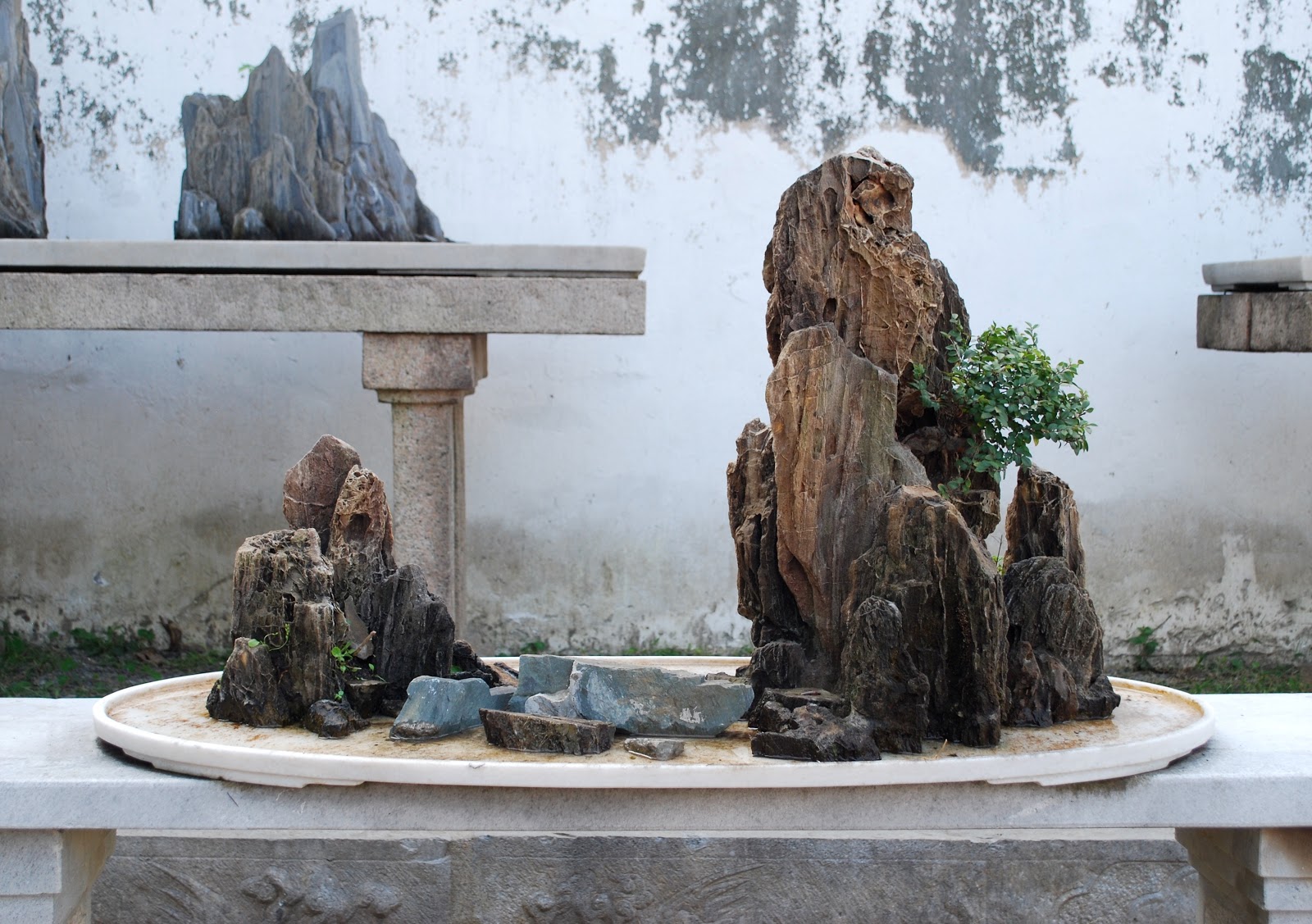
Scholar's stones and penjing in the Penjing Garden - with several, exquisite miniature landscapes to be contemplated.


A view from the Penjing Garden - I can't help, but it reminded me too much of a cemetery... so clinical and so many penjing in dreary stone vessels...

Water forms a large part of the Humble Administrator's Garden; here, a long waterside corridor that winds along the east wall.

 A brief escape from the crowds up to a little hill with a pavilion on the top. "Please follow the official path" - and don't even dream about going back to take a second look at something you missed!