Showing posts with label bonsai. Show all posts

Tuesday, November 13, 2012

Squeezing through the Humble Administrator's Garden

By the entrance to the Humble Administrator's Garden - it is 7:30 AM and the tour guides are already busy waving their flags and gathering their troups. To the left, the Wu Zhu You Ju Pavilion with its striking four moon-shaped door openings and an old phoenix tree in the front (Pavilion of Phoenix Tree and Bamboo).
 
This is it -  Zhuōzhèng Yuán, the Humble Administrator's Garden, is on pretty much every list of remarkable cultural sights to be seen in China. It is considered one of the four most famous gardens in China along with the Summer Palace in Beijing, the Mountain resort of Chengde in Hebei Province and the Liu Lingering Garden, which is also situated Suzhou. In addition, it is a Unesco World Cultural Heritage site, and one of the Cultural Relics of National Importance under the Protection of the State as well as a Special Tourist Attraction (grade AAAAA) of China; the list of accomplishments is quite remarkable for one single garden...  and the crowds are thereafter.
 
The Wu Zhu You Ju Pavilion again, as seen through with its moon-shaped door openings; a rare moment when no-one was in sight; only half a second later this quiet view was gone again.
 
  Ta Ying Ting - Pavilion for Pagoda Reflection at the southwestern corner of the garden.
 
Not just the most visited and renowned, the Humble Administrator's Garden is the largest ancient garden in Suzhou and the whole Yangtze River delta, covering about 52,000 sq. meters (12.85 acres). it was originally built by Wang Xianchen between years 1506 and 1521, who was an administrative censor in the Ming Dynasty. He chose the name to indicate his expectation of retirement and settling into pastoral life (zhuō zhèng means literally humble administrator - in my opinion, a somewhat contradictory name to give for a garden on this scale...). Since then, the garden has changed owners several times and its present architecture and scenery are mostly in the later Qing style.
 
 
Beside the "Lodging for 18 pairs of Lovebirds" with its elegant, blue stained-glass windows, and a light, wisteria-covered stone and cast-iron bridge leading to it. 
 
What would a Chinese garden be without a boat hall? Here, the handsome Xianzhou Stone Boat, embraced by water on three sides and with two levels - it is much larger than many Chinese families real homes...

 The Mountain-in-View Tower is surrounded by water and lotus flower on four sides - when they flower in the early summer, this must be a breathtaking sight.
 
The names of the many pavilions and bridges in the Humble Administrator's Garden are enchantingly poetic. Yuan Xiang Tang - Hall of Remote Fragrance; Yi Yu Xuan - Leaning Against Jade Gallery; Xiao Fei Hong - Little Flying Rainbow Bridge; Xue Xiang Yun Wei Ting - Pavilion of Fragrant Snow and Luxuriant Clouds; Yu Shui Tong Zuo Xuan - Gallery of "With Whom Shall I Sit?" and numerous similar others had caught my imagination long before my visit in books invariably illustrated with ethereal photos where no visitors stir the quiet peace of the garden. Sadly, my experience couldn't have differed more from expectations built up by those pictures. As I mentioned before, my visit fell in the middle of the Golden Week following the Chinese National Day, and literally hundreds of millions were on the road, ticking off the most famous sights on their bucket lists. Instead of spirited wandering through pathways and pavillions, I pretty much squeezed through the gardens, despite hanging at the gates at 7:30 AM when they opened. After starting, there was absolutely no return against the steady flow of tourist groups with extremely loud guides shouting out their stories through microphones despite signs forbidding this explicitly. A bit stressed out - and desperately trying to be positive and see this as an experience in itself - I snapped my photos, often hanging over other people's shoulders or umbrellas or else. So take my advise and do not try to see anything on the lists of cultural wonders mentioned in the first paragraph during the Golden Week, unless you are extremely fond of walking breast to breast with unknown people.
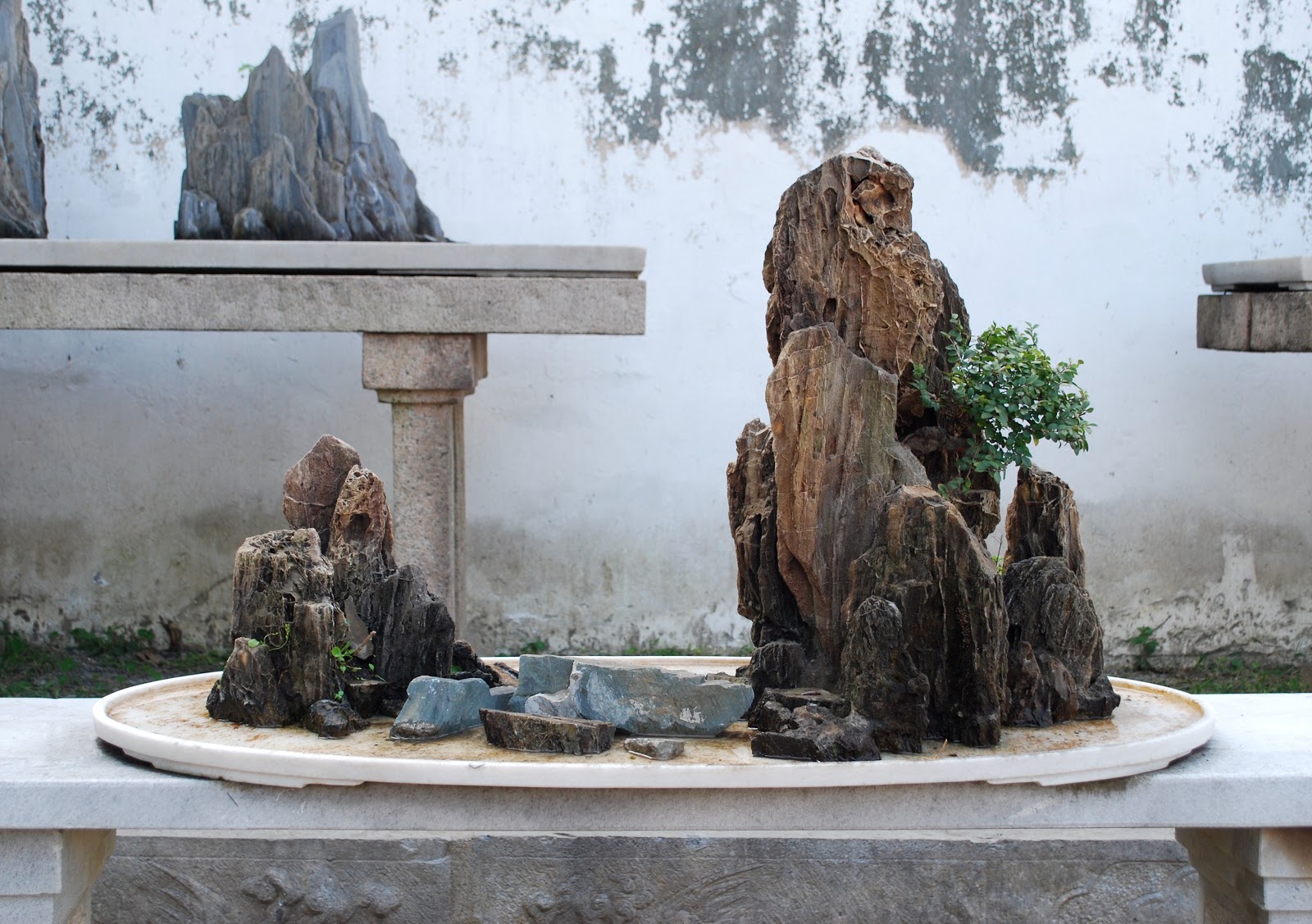
 

Scholar's stones and penjing in the Penjing Garden - with several, exquisite miniature landscapes to be contemplated.


A view from the Penjing Garden - I can't help, but it reminded me too much of a cemetery... so clinical and so many penjing in dreary stone vessels...

Water forms a large part of the Humble Administrator's Garden; here, a long waterside corridor that winds along the east wall.

 A brief escape from the crowds up to a little hill with a pavilion on the top. "Please follow the official path" - and don't even dream about going back to take a second look at something you missed!
 

Thursday, September 13, 2012

You know you are in the tropics when...

A banana bonsai (Musa sp.)- about half a meter high, and quite cute. No fruit in sight, though... 

bonsais come in the genus Musa... as in the Singapore Botanic Gardens collection. I've never encountered one before, but then, I can't really claim to be a bonsai or penjing expert either. This is an enjoyable little collection in a slightly too industrial pavilion (I think the bonsais looked a bit lonely on their perches), but well worth spending a while in.


The bonsai theater, or pavilion - and even if Singapore is very safe, it was guarded by many cameras, just in case...

A mini Chinese Banyan (Ficus macrocarpa); what a lovely tangle of air roots on a plate.

Wild water plum 'Sui Mai' (Wrightia religiosa) like a little island with huge trees.

And another tiered little Wrightia. I can't stand those white plastic signs, they stick in your eyes however much you try to ignore them.

Friday, August 31, 2012

Penjing shaped as Chinese characters

Just need to show this little detail from the Lian Shan Shuang Lin Monastery, the subject of my previous blog post: 

Wandering through the numerous courtyards, I found several penjing skillfully shaped as Chinese characters. Some of them were still in the making, offering an intriguing insight into the pleasantly low tech process that leads to the sophisticated end results. Definitely my kind of engineering. I would love to be able to read these kanji, but need someone to decipher them to me as I have no skills in that area. Definitely another good reason to start Mandarin lessons while here.

Wednesday, August 29, 2012

Stone, water and penjing at the Lian Shan Shuang Lin Monastery

The Mahavira Hall at the Lian Shan Shuang Lin monastery, with large penjing flanking the entryway and steps to the temple.

Pretty much since we came to Singapore, I've been intrigued by a sprawling temple area that sits just a stone throw from a hectic highway, amongst a sea of tall apartment buildings. It is the home of Lian Shan Shuang Lin Monastery, Singapore's oldest Buddhist monastery .

Large, carefully trained penjing (Chinese meaning "tray scenery", a close relative to the Japanese bonsai) in huge planters carved out of single pieces of granite are displayed all over the monastery. They require enormous amounts of maintenance - a sign of reverence.

Elaborate gates lead to the different temples and inner gardens (my favorites) of the monastery.


The history of Lian Shan Shuang Lin Monastery - locals seem to call it only the Shuang Lin temple - reflects Singapore itself. It was founded by a Low Kim Pong, a devoted Buddhist, who in the 1850s left his family and poor circumstances in mainland China for Singapore and became a highly successful entrepreneur here.

The story goes that Low Kim Pong literally dreamt this monastery into being; according to the notes, one night in 1898 he "dreamt of a sacred man, radiating golden light, approaching from the West to the water front. Believing this to be an omen and with a continuing enthusiasm, they went to the waterfront and waited patiently."

Water - an integral element in Chinese gardens - is present in pots, fountains and even a large half-moon pond. I love the huge dragon jars and the little waterlilies with their leaves streaked with dark burgundy.

More water and waterlilies, this time in a huge boulder carved into a birdbath. And another huge, expressive boulder typical to Chinese gardens; unfortunately the sign was in Chinese that I do not understand (yet?).

Luckily for Low Kim Pong, a boat finally arrived at dusk carrying Venerable Xian Hui and his family of 12 Buddhist monks and nuns. After six years of pilgrimage to India, Ceylon and Burma, they were stopping over in Singapore on their way home to China. Xian Hui agreed on Low Kim Pong's vision about founding a Buddhist monastery in Singapore, and he became the first abbot in the new institution built on 50 acres of land donated by Low Kim Pong in what today forms the busy suburb of Toa Payoh.

Petrified and carved stone together with expressive tree trunks form the focal points of the contemplative inner garden rooms.

Both originating from the Fujian province in China, Low Kim Pong and Xian Hui called in craftsmen from their hometowns there as well from the nearby Guangdong province to construct and build the monastery. The result is a blend of architectural styles typical for these regions that reflects the Chinese immigrant society of Singapore at that time. In the late 1900s, it fell into severe disrepair and was even partially closed from time to time. It was only in 1991 that an extensive restoration project (sometimes a bit too enthusiastic - I would have loved to see more patina left in place...) was started, and it is still continuing on many areas of the grounds.

More stone - a symbol of stability and endurance and a integral element of Chinese gardens. On the left, two petrified tree trunks, on the lower right, stone with surface that water has carved into a distinct pattern reminding of waves.

A passageway with several penjing shaped as Chinese characters - if I only would be able to read them!

Wandering through the gates, walkways and temples of the monastery easily transfers one from the daily bustle of Singapore into another, more spiritual world. I especially loved seeing how people and monks were sitting in the inner gardens, meditating and contemplating in silence (of course, no photographing was allowed  inside the temples). I definitely need to know more of the Buddhist religion as now I felt (and of course, am) just like a tourist who appreciates the temples and their beauty solely on their aesthetic and visual values. But even if so much of their deeper meanings were lost on me, just sitting there enjoying the quiet peace of the monastery with a scent of incense wafting around, I know I still gained a lot.

Details, details, everywhere...